text SOFIA MÜLLER
image VINCENT LEROY
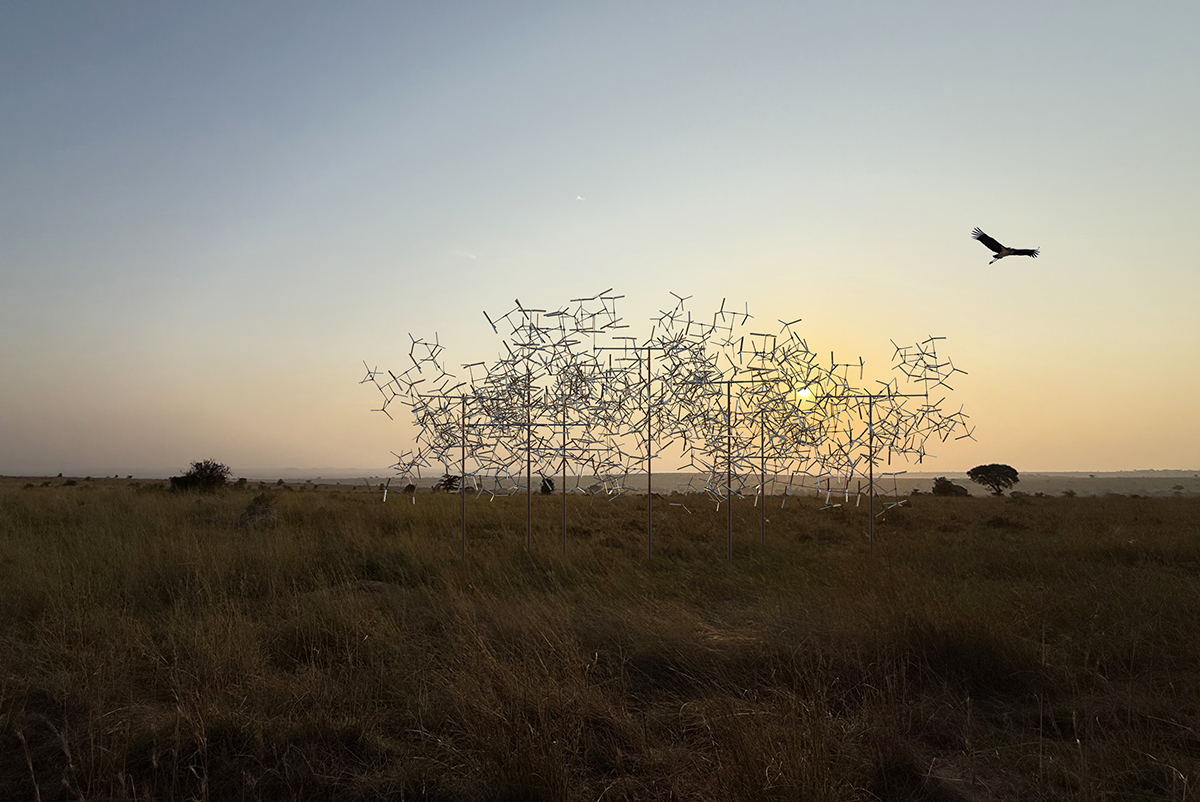
Conceived in the vast openness of the Tanzanian plains, Fractal Swarm by Vincent Leroy situates itself within a landscape defined by exposure, distance, and the constant movement of air. The work does not occupy the site as an object but enters into a reciprocal condition with it, allowing wind, light, and horizon to actively construct its spatial presence.
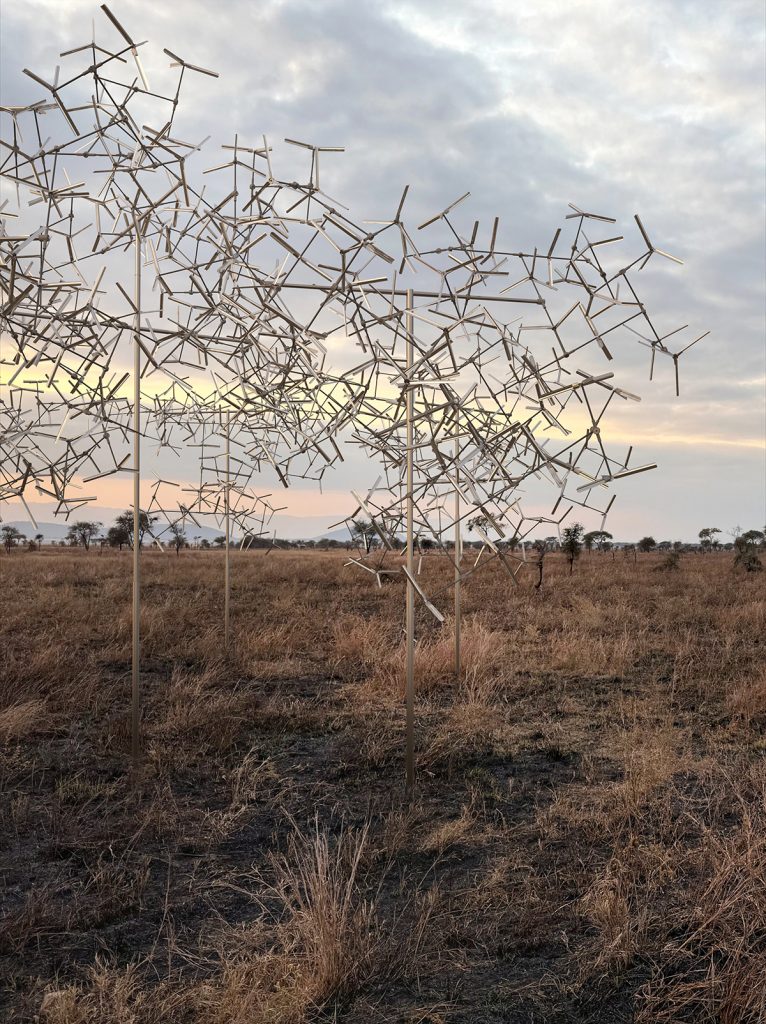
At its origin lies a geometric system based on repetition and self similarity. The installation takes form as an ultra light structure composed of modular elements, some produced through 3D printing, assembled into a fractal configuration. Initially perceived as precise and abstract, the system operates according to a mathematical logic that suggests stability and control. Yet this apparent rigidity is only provisional. Once exposed to the conditions of the site, the structure begins to shift, opening itself to transformation.
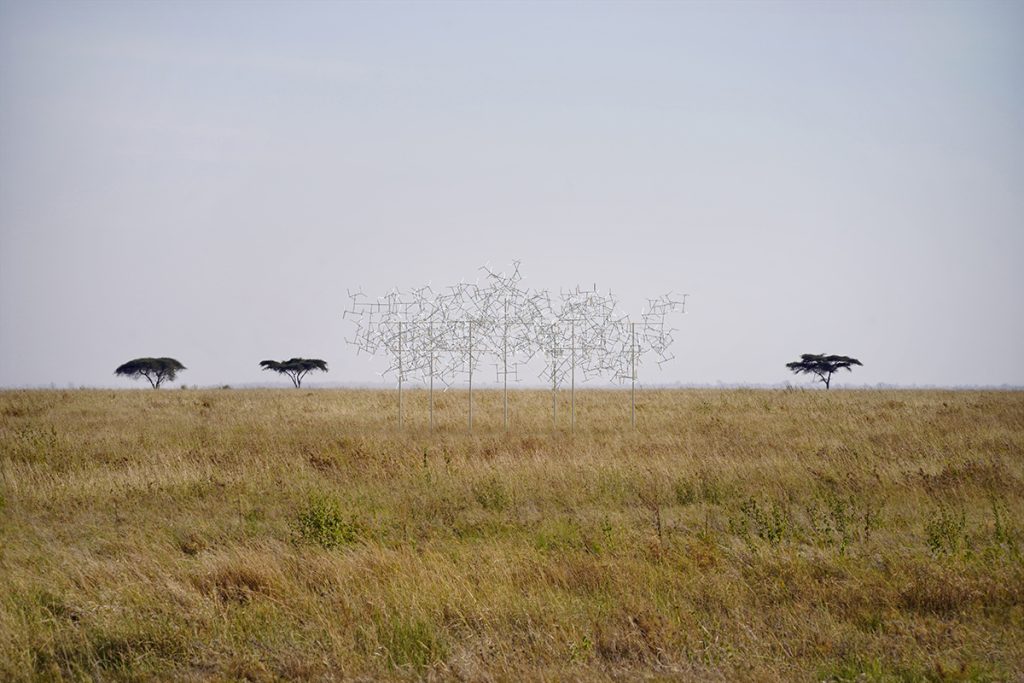
The fractal geometry resonates with the visual language of the surrounding territory. The sparse acacia trees, the dryness of seasonal vegetation, and the fragmented textures of the ground find an echo in the installation’s branching logic. Rather than mimicking the landscape, the work extends its underlying patterns, rendering visible a continuity between natural formation and constructed system.
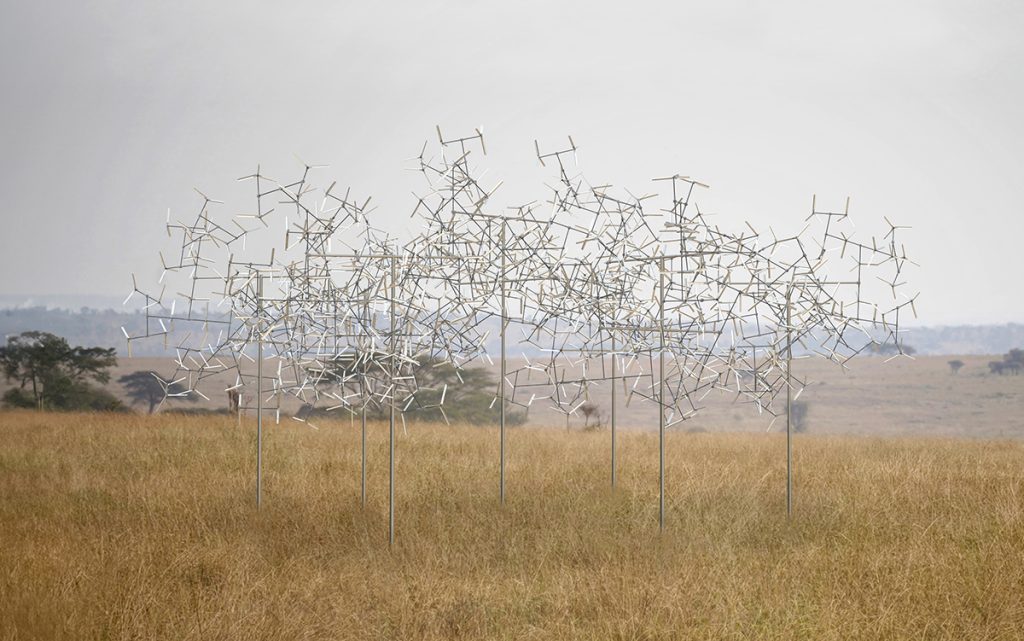
Light plays a decisive role in this process. Thin mirrored fins dispersed across the structure capture and refract the intensity of the equatorial sun. As daylight moves, reflections scatter and recombine, causing the installation to oscillate between visibility and disappearance. At certain moments it asserts itself as a sharp presence against the horizon, while at others it dissolves into a field of flickering fragments.


Activated entirely by wind, the installation exists in a constant state of modulation. Each element responds independently, oscillating and rotating in subtle variations, while the collective form slowly reorganises itself. From a distance, this distributed motion evokes the transient configurations of bird flocks, formations that emerge and dissipate without fixed structure.

Through Fractal Swarm, Leroy proposes a reading of landscape that is neither descriptive nor symbolic, but operative. Geometry becomes a medium through which environmental forces are registered and made perceptible. What begins as a mathematical construct evolves into a spatial drawing in continuous flux, shaped not by the artist alone but by the conditions that surround it.